Categories
Chandigarh Education

Affordable Physics Coaching Classes In Chandigarh with Expert Faculty

Unlock Your Potential: Affordable Physics Coaching Classes in Chandigarh

Are you a student in Chandigarh aiming to excel in Physics for competitive exams like JEE and NEET? If so, you’re in the right place! There are numerous options for affordable Physics coaching classes in Chandigarh that provide expert guidance to help you master this vital subject.

Why Physics Coaching is Essential

Physics can be a challenging subject, often requiring a deep understanding of complex concepts and the ability to solve intricate problems. Whether you are preparing for the IIT JEE or NEET, having a solid foundation in Physics is crucial for success. That’s why enrolling in the best can make all the difference.

What to Look For in Physics Tuition

When searching for physics coaching classes in Chandigarh, it’s important to consider the following aspects:

– Expert Faculty: Look for coaching centers with experienced instructors who specialize in Physics. Expert physics faculty in Chandigarh can provide unique insights and tailored teaching methods that simplify difficult concepts.

– Personalized Attention: Choose institutes that offer a student-friendly environment, allowing for individualized attention. This helps address your specific learning needs and enhances problem-solving skills.

– Proven Results: Opt for coaching institutes known for their result-oriented preparation, especially for exams like JEE and NEET.

Recommended Institutes in Chandigarh

Two prominent names in the field of Physics coaching in Chandigarh are Modgil Classes and Aadhar Institute Online Classes. Both offer exceptional coaching that emphasizes concept-based learning and equips students with the strategies and knowledge needed for examination success.

– Modgil Classes  Aadhar Institute Online Classes: Known for their expert faculty and proven track record, Modgil Classes focus on building a strong foundation in Physics with personalized coaching tailored to individual student needs. For those who prefer online learning, Aadhar Institute offers an effective approach to Physics tuition in Chandigarh. Their digital platform provides interactive sessions that are perfect for learning at your own pace.

Conclusion

If you’re looking for affordable Physics coaching classes in Chandigarh, rest assured, there are excellent options available to help you achieve your academic goals. Invest in your education by joining leading institutes that offer expert guidance, quality education, and a commitment to your success. With the right support, you’ll be well on your way to mastering Physics and excelling in your exams.

For more information about the programs and courses offered, feel free to reach out to 9876106415 or visit aadharinsitutechandigarh.com. Take the first step towards your academic success today!

Categories
Chandigarh Education

NEET Physics Preparation Tips from Chandigarh Experts

Preparing for the NEET exam, particularly in Physics, can be a daunting task for many aspiring medical students. With the competitive nature of the exam and the vast syllabus to cover, effective preparation strategies are essential. This article compiles expert insights and proven tips from renowned coaching centers in Chandigarh, such as Modgil Classes and Aadhar Institute, to guide students through their NEET Physics preparation journey. From understanding the exam structure to mastering fundamental concepts and effective study techniques, these tips aim to equip students with the tools they need to excel in Physics and achieve their dream of entering medical school.

Understanding the NEET Exam Structure

Overview of NEET Exam Format

The NEET (National Eligibility cum Entrance Test) is a 3-hour long, pen-and-paper-based exam comprising 180 multiple-choice questions. These questions are split between Physics, Chemistry, and Biology (Botany and Zoology). With 45 questions from Physics alone, you’ll want to dust off that calculator and make sure you’re well-versed in topics ranging from kinematics to electromagnetism!

Weightage of Physics in NEET

Physics carries a significant weight in the NEET exam, accounting for 25% of the total score. That’s a quarter—so don’t just brush it off like the last cookie in the jar. Since questions are often designed to test your conceptual understanding, mastering Physics can mean the difference between a pass and a panicked scramble for a backup plan.

Importance of Strong Fundamentals in Physics

Key Concepts to Master

To conquer the NEET’s Physics section, focus on key concepts such as mechanics, thermodynamics, electromagnetism, and optics. Don’t worry, you don’t need to memorize every equation, but knowing the fundamental principles will help you tackle problems effectively—think of it as learning the rules before you start playing Monopoly. Otherwise, you could end up in jail… or worse, out of the exam.

Building a Strong Foundation for Advanced Topics

When you’ve nailed the basic principles, you’ll find that advanced topics are much easier to digest. Concepts like wave optics and modern physics build on your fundamental knowledge. It’s like stacking blocks: if the bottom isn’t sturdy, the tower might just collapse during exam day. So, give yourself the gift of a solid foundation!

Effective Study Strategies for NEET Physics

Creating a Study Schedule

A well-planned study schedule is your best friend (sorry, no offense to your actual friends). Allocate specific times for Physics, ensuring you mix in theory, problem-solving, and revision. Remember, consistency beats cramming—study a little bit each day instead of trying to become a physics scholar overnight!

Active Learning Techniques

Instead of just reading and nodding your head like a bobblehead, engage with the material! Use flashcards, diagrams, and summaries. Solve previous years’ question papers to get a feel for the exam. It’s like training for a marathon—practice makes the (not-so-much-of-a) perfect!

Utilizing Group Studies

Don’t underestimate the power of group studies. Collaborating with peers allows for the exchange of ideas and clarifying doubts you didn’t even know you had. Plus, explaining concepts to others can reinforce your own understanding. Just don’t let your study group devolve into a snack-fest—stick to the goal, people!

Resources and Study Materials Recommended by Experts

Textbooks and Reference Books

Stick to the classics! NCERT books serve as the bible for NEET preparation. Top it off with reference Video like Modgil Classes, Aadhar Institute. These gems provide thorough explanations and are a staple for serious NEET aspirants.

Online Resources and Video Lectures

In the age of technology, don’t miss out on the plethora of online resources available. Websites like Modgil Classes, Aadhar Institute, YouTube channels dedicated to NEET prep, and educational apps can enhance your learning experience. Nothing beats a good video tutorial when you’re wondering how to make sense of that equation!

Coaching Classes vs. Self-Study

Coaching classes can provide structure and expert guidance, but self-study allows for flexibility. It’s all about understanding your own learning style. If you thrive in a classroom setting, opt for coaching. If you prefer a solo journey, grab those textbooks and hit the books like a boss. Choose what works best for you and dive in!

Time Management Techniques for NEET Preparation

Setting Realistic Goals

When it comes to preparing for NEET, setting realistic goals is like choosing the right toppings on your pizza — if you go overboard, you might just ruin the whole thing. Break your preparation into bite-sized objectives: daily, weekly, and monthly goals can keep you from feeling overwhelmed. Aim to cover a specific number of topics or hours each day. Celebrate the little wins; they add up faster than you can say “NEET!”

Prioritizing Topics Based on Difficulty

Not all topics are created equal. Some will have you scratching your head, while others feel like a Sunday stroll in the park. Take a cue from the experts in Chandigarh and start by identifying which subjects make you feel like a genius and which ones make you question your life choices. Prioritize tackling the tougher concepts first when your brain is fresh, saving the easier ones for those days when motivation is running on fumes.

Implementing the Pomodoro Technique

Ever heard of the Pomodoro Technique? No, it’s not an Italian dish, though it might help with your appetite for knowledge! This technique involves studying for 25 minutes straight, followed by a 5-minute break (a.k.a. the magical “rest period”). After four pomodoros, reward yourself with a longer break. It’s like tricking your brain into thinking that studying is actually fun. Who knew time management could be spiced up with a little tomato flair?

Mock Tests and Practice Papers: Why They Matter

Benefits of Regular Testing

Mock tests are your best friends during NEET prep, like that overly enthusiastic cheerleader at your school. Regular testing helps you gauge your understanding, reinforces learning, and builds confidence. They reveal which topics you’ve mastered and which ones need a bit more TLC. Plus, they can help you get used to the exam format — something you’ll be thanking yourself for when the real deal arrives!

Analyzing Mock Test Results

So you’ve bravely tackled a mock test — now what? Don’t just shove the results in a drawer and pretend they never happened. Take the time to analyze them! Look out for patterns in your mistakes and identify areas of improvement. This isn’t just about the score; it’s about learning from your faux pas. Think of it as a reflective practice session — the more you dissect, the better your next performance will be.

Simulating Exam Conditions

When it comes to NEET, practice makes perfect, and that includes simulating exam conditions. Find a quiet space, set a timer, and treat your mock test like the actual exam. No peeking at notes or cheating with Google! This will help you manage your time effectively and reduce anxiety on the big day. The more you practice under pressure, the cooler you’ll be when it’s showtime!

Common Mistakes to Avoid During Preparation

Overloading Study Material

We get it — it’s easy to think that more material means more knowledge, but piling on textbooks like they’re the latest fashion trend is a no-go. Focus on quality over quantity! Stick to a few well-chosen resources that explain concepts clearly, instead of drowning in a sea of information. Your brain only has so much storage; avoid turning it into a cluttered attic full of dusty books!

Ignoring Weak Areas

Procrastination can be the slippery slope of preparation. If you’re avoiding certain topics because they’re tough, it’s time for a reality check. Ignoring your weak areas is like ignoring a leaky roof — eventually, it’s going to rain! Dedicate time to tackle these concepts head-on, and don’t hesitate to seek help from your teachers or peers. A strong foundation is key to acing NEET.

Neglecting Time for Revision

Revision isn’t just an accessory; it’s essential for NEET prep. If you think you can cram everything in right before the exam, think again! Set aside regular time to revisit what you’ve learned. This will fortify your memory and help you feel more prepared. Plus, it gives you a chance to pat yourself on the back for all the knowledge you’ve acquired — and who doesn’t love a good pat?

Staying Motivated and Focused Throughout the Journey

Setting Milestones and Rewards

Motivation can be as fleeting as a summer breeze, especially during intense prep. To keep your spirits high, set milestones and reward yourself for achieving them. Finished a tough topic? Treat yourself to a movie night or your favorite dessert. These mini celebrations break the monotony and remind you that all your hard work will pay off in the end (and who doesn’t love a good reward?).

Finding a Study Buddy or Mentor

Studying doesn’t have to be a solitary adventure. Find a study buddy or mentor who shares the same goals, and tackle NEET prep together! It can make a world of difference to have someone to bounce ideas off of, quiz each other, and share study materials. A little camaraderie can go a long way in making the journey more enjoyable and motivating.

Maintaining a Balanced Lifestyle

Lastly, don’t forget that you’re not just a study machine; you’re a human being! Maintaining a balanced lifestyle is crucial. Make sure to include breaks, physical activity, and social interactions in your routine. A healthy body supports a healthy mind, and keep in mind that burnout is not a badge of honor. So, take a moment to breathe, unwind, and recharge — your brain will thank you! In conclusion, approaching NEET Physics preparation with the right strategies and resources can significantly enhance a student’s chances of success. By focusing on strong fundamentals, effective study habits, and regular practice, along with guidance from experts, students can navigate the challenges of the exam with confidence. Remember, consistency and a positive mindset are key to overcoming obstacles on the path to achieving your medical aspirations. Stay dedicated and believe in your ability to succeed!

FAQ

What is the best way to start preparing for NEET Physics?

To begin preparing for NEET Physics, it’s crucial to build a strong foundation by thoroughly understanding the basic concepts and principles. Utilize standard textbooks, create a study schedule, and focus on both theory and problem-solving.

How important are mock tests in NEET preparation?

Mock tests are extremely important, as they help students become familiar with the exam format, improve time management skills, and identify weak areas that need more focus. Regular practice through mock tests can enhance overall performance.

Can I prepare for NEET Physics while balancing other subjects?

Yes, effective time management allows for a balanced approach to studying all subjects. Prioritize your study schedule to allocate sufficient time for Physics while ensuring you also cover Biology and Chemistry adequately.

What resources should I use for effective NEET Physics preparation?

Recommended resources include NCERT textbooks, reference books from Modgil Classes and Aadhar Institute, online courses, and video lectures. Joining a reputable coaching class can also provide structured guidance and support.

Categories
Chandigarh Education

How Physics Coaching In Chandigarh Helps Crack JEE Advanced

Cracking the JEE Advanced exam is a formidable challenge for aspiring engineers in India, and a solid understanding of physics is essential for success. In Chandigarh, two coaching institutes, Modgil Classes and Aadhar Institute, have emerged as prominent centers for physics coaching, offering students the guidance and resources needed to excel. These institutes not only provide comprehensive instruction in key physics concepts but also employ innovative teaching methodologies tailored to meet individual learning needs. Through personalized coaching, strategic problem-solving techniques, and a focus on real-world application, they empower students to build confidence and mastery in physics, ultimately preparing them for the rigors of the JEE Advanced exam. This article explores how these coaching centers are helping students from Chandigarh unlock their potential and achieve their academic goals.

Importance of Physics in JEE Advanced Preparation

Understanding the Exam Structure

Physics plays a crucial role in JEE Advanced, with a significant portion of the exam dedicated to it. The structure typically consists of multiple-choice questions (MCQs) and numerical problems, testing not just rote memorization but your ability to apply concepts in real-world scenarios. In essence, mastering physics is like learning to ride a bicycle; if you don’t get the balance right, you’ll hit the pavement hard!

Key Topics in Physics for JEE Advanced

When diving into physics for JEE Advanced, it’s essential to focus on core areas such as Mechanics, Thermodynamics, Electromagnetism, and Optics. Topics like Kinematics and Laws of Motion are your bread and butter, while more complex concepts like Quantum Mechanics are the cherry on top. Remember, a solid grasp of fundamental principles is just as vital as knowing how to make those tricky calculations.

Overview of Modgil Classes and Aadhar Institute

History and Reputation of Modgil Classes

Modgil Classes has been making waves in Chandigarh’s educational scene for years. Founded with the mission to demystify physics, this institute has carved a niche for itself, turning bewildered students into JEE Advanced contenders with a flick of their wand (or rather, their teaching skills). Alumni rave about the supportive environment and expert faculty, making it a go-to destination for aspiring engineers.

Aadhar Institute’s Approach to Physics Coaching

Aadhar Institute believes that every student can become a physics whiz with the right guidance. Their coaching methodology emphasizes conceptual clarity and problem-solving skills. With a blend of theory and practical application, Aadhar encourages students to think critically and approach physics like a detective solving a mystery case. Spoiler alert: the mystery is usually a number of falling apples!

Teaching Methodologies Employed in Coaching

Innovative Teaching Techniques

At both Modgil Classes and Aadhar Institute, teaching methodologies are anything but conventional. They utilize interactive simulations, group discussions, and real-life examples, making physics less about formulas and more about understanding the universe. These innovative techniques ensure that students are not just passive listeners but active participants in their learning journey. It’s like turning a physics lecture into a lively debate—where the laws of motion might just be up for discussion!

Use of Technology in Learning Physics

In this digital age, technology is a game-changer in learning physics. Both institutes leverage multimedia tools, online quizzes, and virtual labs to enhance understanding. Imagine conducting experiments in a virtual lab without the fear of blowing anything up! This tech-savvy approach not only simplifies complex concepts but also keeps students engaged—because who wouldn’t want to learn physics while playing with cool apps?

Success Stories of Students from Chandigarh

Alumni Testimonials

Graduates from both Modgil Classes and Aadhar Institute frequently share glowing testimonials about their journeys. Many highlight the supportive atmosphere, expert faculty, and effective strategies that made a world of difference. Students fondly remember their “aha!” moments and how those lightbulbs led them to JEE Advanced success. It’s like finding a treasure map in the attic—you just didn’t know it was there until someone pointed it out!

Case Studies of High Achievers

Take, for example, Aman, who went from barely scraping through physics to acing the JEE Advanced with a top score. Thanks to the personalized coaching at Modgil Classes, he transformed his approach to problem-solving and critical thinking. Or consider Neha, a star pupil from Aadhar Institute, whose determination and engaging teaching methods propelled her to secure an impressive rank. These case studies serve as inspirational reminders that with the right coaching, anything is possible—even mastering the mysterious world of physics!

Role of Personalized Coaching in Understanding Concepts

One-on-One Attention and Mentorship

Personalized coaching can feel like a secret weapon in your academic arsenal, especially when it comes to cracking the JEE Advanced. At Modgil Classes and Aadhar Institute, students receive one-on-one attention that is as rare as a unicorn in a physics lab. This focused mentorship means that students can ask questions, clarify doubts, and explore complex theories at their own pace. Coaches often tailor their teaching methods to match the student’s learning style, ensuring that the ‘aha!’ moments happen more frequently than on a Netflix binge-watch.

Customized Study Plans for Students

One size fits all? Not in the world of JEE Advanced preparation! Both Modgil Classes and Aadhar Institute create customized study plans that cater to individual strengths and weaknesses. This means each student gets a roadmap designed specifically for them—like having a GPS to navigate the mysterious highways of physics. With a tailored study plan, students can focus on the topics that need extra attention while still making progress in their overall curriculum. It’s about maximizing efficiency and minimizing confusion—big win all around!

Strategies for Effective Problem-Solving in Physics

Practice Techniques for Mastery

In the realm of physics, practice makes perfect—or at least less imperfect! Modgil Classes and Aadhar Institute emphasize a variety of practice techniques, including mock tests, problem sets, and interactive workshops. By engaging with a plethora of problems, students develop the skills needed to tackle anything that comes their way on exam day. It’s like preparing for a marathon, but instead of running, you’re running through equations and concepts until you feel like an Olympian of physics!

Common Mistakes and How to Avoid Them

Let’s face it, mistakes are part of learning—and sometimes, they can be downright embarrassing. Both Modgil Classes and Aadhar Institute help students identify common pitfalls, such as misreading a question or skipping essential steps in a calculation. By understanding these traps, students can sidestep them like a seasoned gamer dodging a video game boss. Learning to recognize and rectify these mistakes not only boosts confidence but also transforms the dreaded exam into just another challenge to conquer.

Comparing Modgil Classes and Aadhar Institute: Which is Right for You?

Curriculum Differences

When choosing between Modgil Classes and Aadhar Institute, curriculum can be a game-changer. Modgil may place more emphasis on conceptual clarity, while Aadhar might focus on application-based learning. Both have their charms, but understanding their unique approaches can help students align their study preferences with what each institute offers. Think of it like choosing between two different recipes for the same dish—one might have more spice, while the other is all about the texture.

Instructor Qualifications and Experience

Quality teaching is like a fine wine; it gets better with age and careful selection! Both Modgil Classes and Aadhar Institute pride themselves on having experienced faculty who not only know physics but also know how to communicate complex ideas in a digestible way. When comparing these institutes, students should consider instructors’ qualifications and teaching styles as these factors can significantly influence their learning journey. After all, you wouldn’t want to learn physics from someone who can’t even spell “quantum,” would you?

Tips for Maximizing Your Coaching Experience in Chandigarh

Time Management Strategies

Time management is the unsung hero of academic success. With the overwhelming syllabus for JEE Advanced, students at Modgil Classes and Aadhar Institute are trained to prioritize tasks and allocate study time wisely. Simple strategies like the Pomodoro Technique (25 minutes of focused study followed by a 5-minute break) can turn chaotic schedules into neat plans. This not only helps in maintaining focus but also keeps procrastination at bay—like a superhero warding off villains!

Balancing Coaching with Self-Study

Striking the perfect balance between coaching and self-study is akin to walking a tightrope—exciting, yet terrifying! At both Modgil Classes and Aadhar Institute, students are encouraged to complement their coaching with self-study. This might include dedicating certain hours each week to revision or delving deeper into topics discussed in class. The key is to create a harmony where both aspects support each other—making your learning experience robust and effective, just like a well-tuned guitar!In conclusion, the role of dedicated coaching institutes like Modgil Classes and Aadhar Institute in Chandigarh cannot be overstated when it comes to preparing for the JEE Advanced exam. Through expert guidance, tailored study plans, and innovative teaching methods, these institutes equip students with the knowledge and confidence needed to tackle the complexities of physics. As students continue to strive for excellence in their academic journeys, the support from these coaching centers remains a vital component in their quest for success in one of the country’s most challenging engineering entrance exams.

FAQ

What are the key features of Modgil Classes and Aadhar Institute?

Both Modgil Classes and Aadhar Institute offer experienced faculty, personalized coaching, and a focus on problem-solving techniques tailored for JEE Advanced preparation. They also utilize modern teaching methods and technology to enhance the learning experience.

How do I choose between Modgil Classes and Aadhar Institute?

Choosing between the two institutes can depend on various factors such as faculty expertise, curriculum structure, student reviews, and location. It is advisable to visit both institutes, attend demo classes, and consult current or former students to make an informed decision.

What should I expect from physics coaching at these institutes?

Students can expect a comprehensive curriculum covering key physics topics, regular assessments to track progress, personalized attention from instructors, and strategies to develop problem-solving skills essential for JEE Advanced.

Is coaching necessary for cracking JEE Advanced?

While coaching can significantly enhance understanding and preparation, it is not strictly necessary. Many students have successfully prepared for JEE Advanced through self-study. However, coaching can provide structured guidance and resources that may be beneficial for many candidates.

Categories
Education

Choosing a school for your daughter, and why a school tour might help you make a decision

While going through the journey of choosing a school for your daughter, there are several key considerations you can look at to help make the best decision. One great way is to tour a school, helping clarify if a leading all girls school, like Penrhos College has everything you desire.

Key considerations when choosing a new school

There are many reasons to choose a new school, from an easy-to-reach location, to a focus on individual learning pathways, to gaining additional support for your daughter. Depending on your family’s goals and ideal budget, major considerations will take priority.

Deciding between a public vs private all girls school

One of the biggest decisions a parent has to make when choosing between schools in Perth is between public and private schools. The main practical difference is public schools are free and private colleges are not, but there are also eligibility conditions to take into account.

Public schools typically operate with catchment zones, where the location of your primary address determines whether your children are accepted. Private schools tend to have a specific admission process, where smaller class sizes and high quality facilities are a huge benefit to a productive learning environment.

What are the benefits of a girls private school in Perth?

The specialised education offered by an all girls private school like Penrhos College are endless, with a clear focus on building the esteem and confidence of these young women as they grow and develop. By allowing girls to shine they can learn to become empowered, and many all-girl school graduates go on to strive for leadership positions later in life.

It’s been shown that single-sex schools improve the social well-being and self-esteem of young girls, where smaller class sizes and a lack of peer pressure benefit their learning experience.

All-girls schools provide an environment that fosters more than just academic achievement, their focus is on long-lasting skills, motivation and life success — from deeper involvement in leadership roles and a stronger sense of self-worth, to paths that lead girls onto higher education and successful careers in many industries.

How important is it to tour a school?

Carrying out online research is naturally a great way to discover the best schools in your area, and to find the right leading girls private school in Perth for your child. However, there is no replacement for visiting a school in person to tour the grounds and facilities, and meet with both the students and teachers.

School visits are a powerful tool for both parents and children to gain a deeper understanding of not only what a school has to offer, but what their personal priorities are when selecting the right college. Whether you join a guided tour event to experience the campus and meet the staff, or opt for a personalised tour for added flexibility, you’ll leave with a clear idea of the school’s capabilities and ethos.

If an in-person tour is not feasible, Penrhos College offers an innovative virtual tour.

The next steps

Penrhos College is proud to be one of the leading schools in Perth, providing a superior, inclusive education for girls through tailored teaching practices and impeccable facilities. The hard work carried out by award-winning teachers is focused on helping each girl achieve their personal best, with high ATAR results and outstanding co-curricular programs showcasing our ongoing success.

Contact us today with any questions, or email enrol@penrhos.wa.edu.au to book a personalised tour.

Categories
Education

The most comprehensive guide to PMP exam questions [2022]

Read through any active PMP forum on the internet or talk to any PMP exam candidate, and they’ll swear by solving a variety of PMP practice questions and understanding its all possible types and styles.

The PMP certification exam is notoriously unpredictable, and PMI has a reputation of surprising candidates when they least expect it. Therefore, in this comprehensive guide to PMP exam questions, I will discuss all the possible types of PMP exam questions that you can expect during the grueling 230 minutes of your PMP certification exam.

In addition to the PMP exam question types, I’ve also added two more dimensions to PMP exam questions, i.e., style of exam questions and exam question topics (popular topics from where you can expect questions in the PMP exam)

Additionally, in this detailed PMP exam questions guide, I’ve also answered the following questions for you:

  1. How many questions does the PMP exam have?

  2. How many correct answers do you need to pass the PMP exam?

  3. What are pretest questions and the purpose of using them in the PMP certification exam?

  4. How to spot the correct answers while answering PMP certification exam questions?


Types of PMP Exam questions

This first section covers the list of PMP exam questions types, which are:

  1. Multiple-choice questions

  2. Multiple response questions

  3. Matching questions

  4. Hotspot questions

Multiple-choice questions

Until 2020, this exam question type was the only type used in the PMP exam. We’re all probably familiar with this type of question if we’ve done other certification exams in the past. In this question type, candidates must select one correct answer from a list of choices. Generally, there would be four choices from which you will have to choose the right option. This type of question still dominates the majority of the PMP certification exam. Easy as it might sound, these questions can be pretty difficult for candidates because most candidates get stuck between two very close choices in these types of questions.

Here is an example of a multiple-choice question below:

Baselines are an important input to a number of project processes. Outputs of many processes raise change requests to these baselines. Which of the following is not a valid project baseline?

A. Scope baseline

B. Risk baseline

C. Cost baseline

D. Schedule baseline

Correct Answer: B

Explanation: The risk baseline is not a valid project baseline. It is an accepted and approved project plan.

Multiple-response question

This is another type of PMP exam question type that has been introduced in the 2021 version of the PMP certification exam. The candidate has to select multiple correct responses from the list of options presented to them in the question type. All correct answers must be marked to get the question right and earn a point. Generally, the candidate has to select two or three correct answers, and the question will specify the number of correct answers.

Here is a multiple-response sample question below:

Due to a significant delay in some scheduled tasks, the project manager had to reprioritize several subsequent tasks to fix the problem. Unfortunately, that didn’t work either, and now the project manager must escalate the issue.

Which documents must the project manager look at from the options below to escalate the issue? (Choose two answers)

A. Change management plan

B. Stakeholder engagement plan

C. Communications management plan

D. Risk management plan

E. Configuration management plan

Correct Answer: B and C

Explanation: This delay has caused a scheduling issue that must be escalated. The project manager would use the stakeholder engagement plan since it will tell him how to engage with stakeholders. The communications management plan helps ensure that his messages are communicated to stakeholders in various formats and means as defined by the communication strategy.

Matching Question

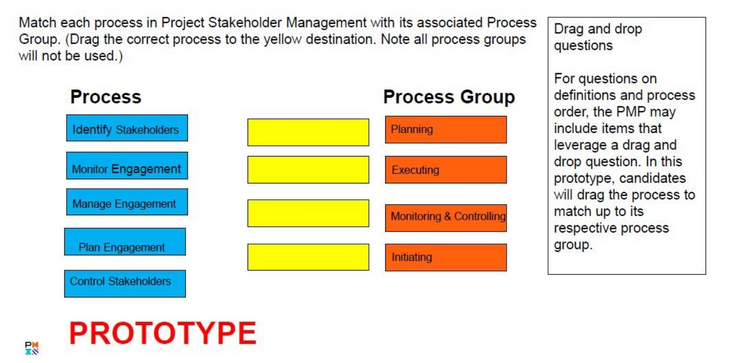
The third type of PMP Exam question is called a matching question. This kind of question includes two sets of items that need to be matched. You must match all the options correctly to earn a mark.

Here is an example of a matching question below [from the PMI website]:
Fill-in-the-blank questions

The next question type is a fill-in-the-blank question. In this type of question, the candidate writes the missing information into the blank space.

The example below shows a fill-in-the-blank question:

______________ is the name of the technique used for doing root cause analysis.

A. Kaizen

B. Ishikawa Diagram

C. A3 thinking

D. Six Sigma

Correct Answer: B

Explanation: Ishikawa diagrams or fishbone diagrams are used to perform root cause analysis

Hotspot questions

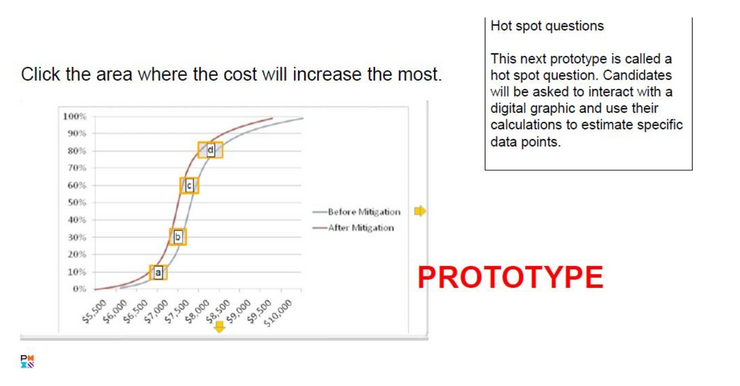
The final question type is the hotspot question. In this question type, the candidate is presented with a picture instead of a text-based question. The candidate has to interact with the image and click on an area of the image to provide the correct answer.

Here is an example of a hotspot question below [from the PMI website]:
Different Styles of PMP Exam Questions

In addition to the various question types, PMI also has crafted different questioning styles to test your project management knowledge. These are styles that have been used consistently by PMI in the PMP certification exam. They range from directly testing a definition from the PMBOK to complex and lengthy scenario-based questions that require situation analysis before choosing an answer.

In the list below, I’ll cover all the different styles of PMP Exam questions.

  1. Definition/knowledge Based questions

  2. Formula based questions

  3. Interpretational questions

  4. PM Technique based questions

  5. Scenario/Situational Questions

  6. PMP ITTOs based questions

Definition/Knowledge-based questions

Knowledge-based questions rely on your memory and understanding of the terms in the PMBOK Guide. They are direct definitions or concepts taken from the PMBOK Guide and cover topics such as the project management process groups, the individual processes used across numerous knowledge areas, and the inputs, tools, and techniques applied in a project management process.

Here’s an instance of a knowledge-based question:

You have received an urgent call from management and they asked you to find the cost estimate of a new project. Since time is critical and you have to provide them with the cost estimate, which technique will you use to calculate the project cost?

A. Parametric

B. Analogous

C. Bottom Up

D. Triangular Estimate

Correct Answer: B

Explanation: In all estimating techniques, the analogous cost estimation is the fastest. In this estimation, you see the cost of any past similar project and apply the parameters to your project and get the approximate cost. Reference: The PMBOK Guide, 6th Edition, Page: 244

Formula based questions

While preparing for the PMP certification exam, you will discover many mathematical formulas used in different PMP exam topics such as schedule, cost, procurement, risk, and communication. You’ll have to apply formulas to solve these questions.

Here’s an example of a formula-based question:

Assuming your past performance will be the same as the future performance, you have calculated the EAC as 250,000 USD. Your previous budget was 200,000 USD and you have earned 50,000 USD to date. What is the money spent to date?

A. 40,000 USD

B. 50,000 USD

C. 90,000 USD

D. 62,5000 USD

Correct Answer: D

Explanation:
Given in the question:
EAC = 250,000 USD
BAC = 200,000 USD
EV = 50,000 USD
Since the future cost performance will be the same as the past cost performance, you will use the formula:
EAC = BAC / CPI 250,000 = 200,000 / CPI
CPI = 200,000 / 250,000 = 0.8
Now we know that: CPI = EV / AC AC = EV / CPI = 50,000 / 0.8 = 62,500 The money spent to date is 62,500 USD

Interpretational questions

Interpretational questions require you to analyze the data provided and draw the correct conclusions. Over the years, such questions have been seen more from the cost and schedule management chapters of the PMBOK.

Here’s an example of an Interpretational question:

A construction project has an SPI of 1.05 and a CPI of 0.96. Based on this information, which of the following statements is most likely to be true?

A. The project manager misjudged the local labor market and was not able to hire enough workers, and some machinery broke down requiring expensive repairs.

B. The project manager was able to find a new vendor who supplied materials for less than the original estimates, and process improvements helped shorten the schedule.

C. The project manager failed to manage stakeholders effectively, and community protests delayed the project, causing the project to consume fewer resources.

D. A subcontractor finished some tasks more quickly than estimated, and the project had to pay more for materials than originally estimated.

Answer: D

Explanation: The correct answer is that a subcontractor finished tasks more quickly than estimated, and the project had to pay more for materials than originally estimated, because both of those events align with the SPI and CPI provided in the scenario. An SPI of 1.05 means that the project is using its time more efficiently than originally estimated; a CPI of less than 1 indicates that the project is over budget; therefore, the correct answer is one that accounts for a project that is ahead of schedule and over budget.

Project Management Technique based questions

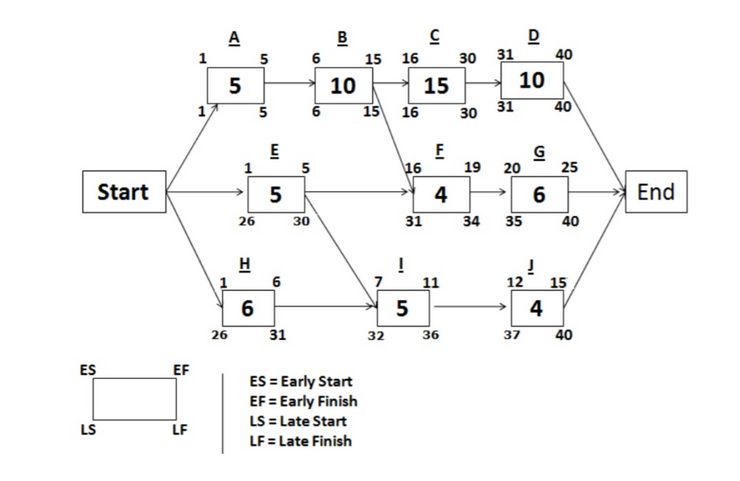
In the world of project management, several techniques can be employed to plan, monitor, and control a project. For example, these could be a precedence diagramming method (PDM) or critical path method in schedule management. In such questions, you will have to apply the technique and arrive at the right answer.

Here’s an example of a network diagram question from the schedule management chapter:

Based on the table shown below identify the Critical Path (draw the network diagram considering day 1 as the first day of the project. Answers to questions are based on the diagram considering day 1 as the first day of the project).
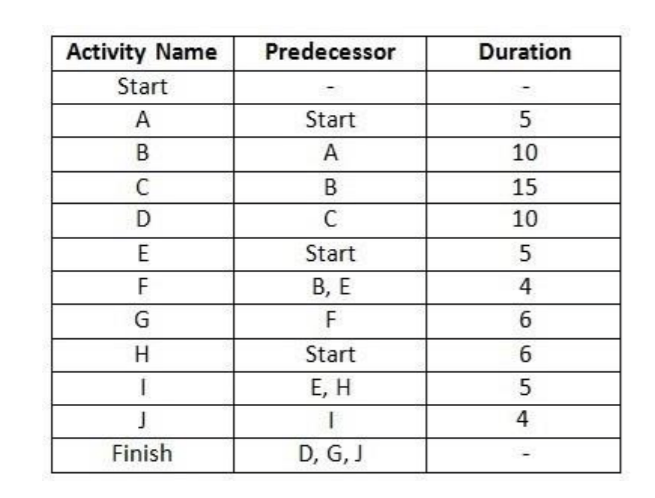
A. Path HIJ

B. Path ABFG

C. Path EFG

D. Path ABCD

Correct Answer: D

Explanation: See the image below for an explanation.


Scenario/Situation Questions

This has been the dominant style of questioning in the PMP exam since the start of 2021. Situational questions will describe a situation that the project is facing, and as a project manager, you have to decide how to deal with the situation.

Situational questions usually end with statements like these given below:

1. What should the project manager do next?

2. What should the project manager do first?

3. How could have the project manager prevented the situation from happening?

Here’s an example of a situational question:


An innovative blockchain software product is nearing completion. Since the software is one of a kind, a software training program for end-users has been included within the scope of the project. However, the project manager has noticed that only a handful of end-users have completed the training so far. What must the project manager do next?

A. Update the risk register to document the concern and develop a plan to ensure end-users complete their training

B. Revise the risk register and discuss it at the next project status meeting.

C. Dedicate additional resources post-implementation of the project to mitigate the risk.

D. Modify the project schedule to account for training delays.

Correct Answer: A

Explanation: The project manager should document the risk and then work with the stakeholder to address this risk. They are probably aware of it and need help to complete the step.

PMP ITTOs based question

ITTO based questions are also a popular type of questioning style in the PMP exam. Each PMP knowledge area has various processes in it, and each process has inputs, tools, techniques, and outputs. The exam tests you on your understanding of these inputs, tools, techniques, and outputs, and hence, questions are more direct than situational questions.

Here’s an example of a PMP ITTOs question:

You are in the process of developing the strategy to engage your project stakeholders. Which of the following will you not do during this process?

A. Develop a stakeholder management plan

B. Develop stakeholder register

C. Update the project schedule

D. None of the above

Correct Answer: B

Explanation: The stakeholder register is developed in the identify stakeholders process. Reference: The PMBOK Guide, 6th Edition, Page: 507, 514

PMP Exam Topics Questions

Predictive approach questions

Before agile came along, predictive/waterfall was the defacto project management approach widely used to manage projects across various sectors and industries. Even the PMBOK6 content is primarily focused on covering processes and techniques associated with a predictive approach. Therefore, you must expect a large number of predictive style questions.

Here’s an example of a predictive situational style question:

You are managing a complex, critical project and have put in a lot of effort to make the team technically proficient during the process. The project is in the final acceptance testing stage when a senior resource, Tiffany, comes to discuss her plans of continuing her education and leaving this current assignment. She would require a positive recommendation for work from you to fulfill admission requirements. What should you do?

A. Tell her that you wouldn’t recommend her as she has broken your trust by leaving the project before closure

B. Ask the Functional Manager to remove her from the project and give her a negative recommendation

C. Discuss and plan her exit so that it would have the least impact on the project schedule

D. Compliment Tiffany on her decision and suggest that she can leave the project whenever she likes as you would handle her additional responsibilities

Correct Answer: C

Explanation: The Project Manager should take steps to minimize the impact of any change that can affect the ‘triple constraints in the project. Option D is wrong and it sets a wrong example.

Agile approach questions
More and more companies are going digital, building software to improve their business operations, and using agile development techniques and frameworks to do it. Agile is gradually taking center stage, and PMI has evolved the PMP exam to ensure it stays abreast with the latest trends in the industry. Hence, from Jan 2021 onwards, 50% of the PMP exam is focused on agile approaches. Thus, neglecting agile concepts will significantly impact your PMP exam performance.

Here’s an example of an agile PMP question:

A project’s daily stand-up meetings are long, often lasting more than two hours. The project team uses the stand-up meetings for extended discussions about solutions to project obstacles. What should the project manager do to improve the daily stand-up meetings?

A. Allow the meetings to remain long but ensure that the time is productive by using an agenda and recording minutes.

B. Timebox each speaker using a stopwatch in stand-up meetings.

C. Nominate a team member to manage obstacles and schedule meetings to discuss possible solutions.

D. Coach team members towards shortening stand-up meetings to 10-15 minutes and improve their method for identifying solutions

Correct Answer: D

Explanation: Daily stand-ups are important meetings for agile teams. The project manager should coach the team in how a daily stand-up meeting is run and what is discussed. Teams run their own stand-ups, and when run well, they can be very useful. Daily stand-ups are typically 10-15 mins and three questions are answered: 1 What did you do since the last stand-up? 2) What will you do today? 3) Are there any impediments or roadblocks? Hold separate meetings to discuss the blockers and find the solution.

Hybrid approach questions

Many companies have realized that it’s not an either-or battle between predictive and agile approaches in the project management world. Instead, both approaches can coexist in an organization and even in the same project. The combination of predictive and agile frameworks in the same project or program is called the hybrid approach, bringing a healthy balance to a project. While evolving the PMP exam into its 2021 version, PMI has ensured a fair number of hybrid project management questions in the PMP exam.

Below is an example of a hybrid PMP question:

Company X’s IT transformation project has three (3) deliverables, and they have the following characteristics, according to the project team:
• Deliverable two has strictly scheduled milestones, with no expected variation in the timeline.
• Requirements for deliverables 1 and 3 will change quickly during development.
Which project lifecycle should the project manager use for this project?

A. Select an agile lifecycle, with a common user story and three-week sprints.

B. Select a waterfall project approach for deliverables, with firm milestones and change control procedures.

C. Select a hybrid project approach; position deliverable 2 as a single agile sprint embedded in an overall waterfall project.

D. Select a hybrid project approach; position deliverable 2 as a single waterfall phase embedded in an overall agile project.

Correct Answer: D

Explanation: In this project, two (2) deliverables have unknown durations or changing requirement sets-both of which are appropriate conditions for use of the agile lifecycle. Deliverable 2 requires strict schedule control and external dependencies, which require a traditional or waterfall project lifecycle.

With the various types of questions out of the way, let’s answer some common questions about the PMP exam.

1. How many questions does the PMP exam have?

The current PMP certification exam contains 180 questions, out of which 175 are scored. The remaining five are not scored. These questions come from 3 different domains, and they are as follows:

People: 42%

Process: 50%

Business Environment: 8%

Apart from this, you’ll encounter numerous questions from the types and styles of questions mentioned above. It is generally believed that situational questions form the bulk of the exam, but nobody knows if it’s true. PMI keeps on changing the Exam Content Outline (ECO) and the exam format.

2. How many correct answers do you need to pass the PMP exam?

The passing grade for the PMP exam used to be about 61% before 2007. In 2007, PMI changed the passing percentage for the PMP exam, and it still remains a secret. Your exam results page will only show if you were ‘Below Target,’ ‘On Target’ or ‘Above Target’ in the three different domains of People, Process, and Business Environment.

3. What are pre-test questions and the purpose of using them in the PMP certification exam?

In the current exam, there are five pre-test questions. These are not scored and inserted throughout the exam. PMI puts in these questions to determine if they are valid by analyzing numerous test takers’ results. If found valid, they can be used as questions in the actual exam.

4. How to spot the correct answers while answering PMP certification exam questions?

Spotting correct answers in the PMP exam boils down to factors such as your knowledge of the PMP exam materials, your comprehension, and situation analysis abilities, and types of questions you solved while doing practice exams. If you’ve taken the time to go over the PMP exam materials thoroughly, understood and absorbed the concepts, invested the time to practice various practice tests, and filled the gaps in knowledge, you will be well-positioned to tackle the questions in the PMP exam.

Here are four simple steps to get questions right in the PMP exam:

1. Read the question patiently and slowly. Focus on comprehending the situation or challenge in the question.

2. Read all options (again slowly). Make sure you understand them.

3. Eliminate extreme answer responses. Look for answer choices that indicate an impulsive decision. They are generally wrong.

4. Evaluate the remaining options in the context of the question and choose the best possible option.

Most answers will link back to a concept that you have read before. If you don’t know the answer, take a best guess. That’s better than not answering the question since there aren’t any negative marks for incorrect answers.

Final words

The PMP exam is challenging, and it’s evidenced by the high failure rates on the first try. It’s not only a test of your knowledge of the PMBOK but also your ability to apply the knowledge to a real-life situation. However, you can achieve this coveted designation with focus, discipline, patience, and consistent effort.

In addition to reading the PMBOK at least once, practicing various PMP exam practice questions is a time-tested and proven strategy for clearing the PMP exam.

Categories
Education News

Study Masters Degree In The University Of Canada

When it comes to seeking a Master’s Degree with an excellent educational background, Canada is the perfect choice for you. World-class education that is supplemented with values cast the students of the University of Canada.

Canada and Canadian universities are the most sought out ones. The reason is that these are some of the top countries in the world that offers outstanding education and training.

Why study for a Master’s Degree in Canada?

● The Canadian University is recognized globally for pursuing an education in Canada. This ensures a firm reputation along with recognition for the students.
● The Universities in Canada facilitate students with scholarships for letting them meet their academic standards.
● The campus life is unmatchable at the universities in Canada. The facilities and amenities are open to every student. Social life within the campus is also excellent. The campus life under the Education System of Canada from events to parties assures growth and development of the potentials and skills of students.
● There is also an assurance of employment opportunity for those students who have done graduation from the institutions of Canada. There is always a job for those students who have completed their education at the University of Canada. The reason is that the education system of Canada is ranked top globally.
● The research is also extremely necessary for those students who are going to pursue their Masters’s degrees. Scholarships and absolute support are offered for research ideas for the students. Along with this lecture, assistance is also available for academic projects.
● With amazing weather, Canada is a beautiful country. It has much more to serve you and its sights are also enthralling.

Top Universities for Master’s Degree in Canada

Canada facilitates students with the best education with recognized universities across the country. Some of the top universities for master degrees in Canada are:

● University Of Waterloo
● Ontario
● McMaster University etc.
● University Of Toronto
● Ontario
● McGill University
● Montreal
● Quebec
● Queens University
● Kingston
● University Of British Columbia
● Vancouver
● BC
● Concordia University
● Montreal
● Quebec

Study Master’s Degree in Canada

There is a huge range of streams for students to choose from in the Education System of Canada. Each field of study has its own detailed curriculum which is served to the students by the specialized and excellent faculty of the universities in Canada. Given below are some of the top Master’s Degree in Canada are:

● Master of Global Management
● Masters of Management in Finance (MMF)
● Master of Fine Arts
● Master of Medical Biotechnology
● Master of Theology (Th.M)
● Masters of Management in Analytics
● Master of Health Administration (MHA)
● Master of Engineering Leadership in Marine Engineering & Naval Architecture